
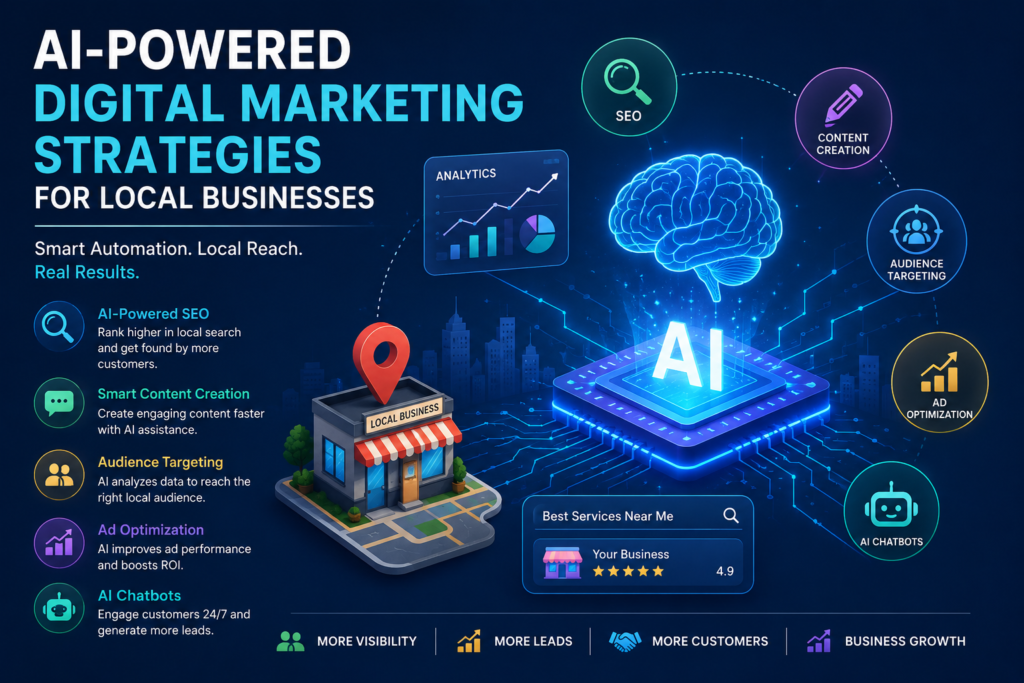
Artificial Intelligence (AI) is changing the way businesses approach digital marketing. From creating content and analyzing customer behavior to optimizing advertising campaigns and improving search visibility, AI tools are helping businesses make faster and more informed marketing decisions.
For local businesses, AI can be especially valuable. Small businesses often have limited budgets, smaller marketing teams, and less time to manage multiple digital channels. AI-powered tools can help automate repetitive tasks while providing useful insights that allow businesses to focus on customers and growth.
Whether you own a restaurant, healthcare clinic, retail store, educational institution, real estate business, professional service, or startup, implementing AI-powered digital marketing strategies for local businesses can help you improve online visibility, attract potential customers, and compete more effectively.
In this blog, let’s explore how local businesses can use AI to strengthen their digital marketing strategy.
What Is AI-Powered Digital Marketing?
AI-powered digital marketing involves using artificial intelligence and machine-learning technologies to improve different aspects of online marketing.
AI can analyze large amounts of information, identify patterns, generate content ideas, assist with customer communication, and help marketers make data-driven decisions.
Some common applications include:
- AI-powered SEO
- Content creation
- Customer segmentation
- Chatbots
- Social media management
- Advertising optimization
- Keyword research
- Competitor analysis
- Email personalization
- Marketing analytics
- Lead scoring
AI does not replace the need for a marketing strategy. Instead, it can help marketers execute tasks more efficiently and make better use of available data.
1. Use AI for Local SEO
Local SEO is one of the most important digital marketing strategies for businesses that serve a specific geographical area.
Customers frequently search for businesses using terms such as:
- “restaurant near me”
- “dentist in Coimbatore”
- “SEO expert in Coimbatore”
- “best salon near me”
- “digital marketing services in Coimbatore”
AI tools can assist marketers with keyword research by identifying relevant search terms, related topics, and potential content opportunities.
How AI Can Support Local SEO
AI can help with:
- Finding local keyword ideas
- Grouping keywords by search intent
- Creating content outlines
- Identifying content gaps
- Analyzing competitors
- Improving website content
- Generating FAQ ideas
- Supporting local content strategies
However, AI-generated recommendations should always be reviewed by a human marketer. Local SEO requires genuine business information and useful content that actually helps customers.
2. Improve Google Business Profile Content
For many local businesses, a Google Business Profile is an important part of their online presence.
AI can help businesses develop ideas for:
- Business updates
- Promotional posts
- Service descriptions
- Frequently asked questions
- Customer communication templates
- Content calendars
For example, a restaurant could use AI to generate content ideas around new menu items, seasonal offers, customer experiences, or special events.
The information should always be accurate and reflect the actual services offered by the business.
3. Create Better Content Faster
Content marketing requires consistency. However, creating fresh content every week can be difficult for small businesses.
AI can help accelerate the content creation process by generating:
- Blog ideas
- Social media captions
- Content outlines
- Video scripts
- Email drafts
- Ad copy
- FAQs
- Headlines
For example, a local fitness center could create a monthly content plan covering fitness tips, healthy lifestyle advice, customer questions, and service information.
The best approach is to use AI as a content assistant, not as a replacement for human expertise.
Businesses should add their own experiences, examples, opinions, brand voice, and accurate information to make the content useful and authentic.
4. Personalize Customer Marketing
Customers respond better to relevant communication.
AI can help businesses analyze customer information and organize audiences based on factors such as:
- Previous purchases
- Website activity
- Location
- Interests
- Engagement
- Customer preferences
For example, an e-commerce business could send different messages to customers who purchased recently and customers who haven’t purchased for several months.
Personalization can make marketing communication more relevant and improve customer engagement.
5. Use AI Chatbots for Customer Support
AI-powered chatbots can help local businesses respond to common customer questions.
A chatbot can potentially assist with questions about:
- Business hours
- Services
- Pricing information
- Location
- Appointment processes
- Booking procedures
- Frequently asked questions
For example, a healthcare clinic could use an automated assistant to provide basic information about available services and appointment procedures.
However, businesses in sensitive industries should ensure that automated systems do not provide inappropriate professional advice. Customer conversations should be handled carefully, with human support available when necessary.
6. Improve Social Media Marketing
Managing multiple social media platforms can be time-consuming.
AI can help local businesses develop social media strategies by generating content ideas based on their industry and audience.
For example, a local café could create content around:
- New products
- Customer stories
- Behind-the-scenes content
- Seasonal promotions
- Food tips
- Special events
AI can also help create variations of captions and content formats for different platforms.
However, social media should still feel human. Real photos, customer stories, local events, and genuine interactions are often more valuable than generic AI-generated content.
7. Use AI for Advertising Optimization
Paid advertising can become expensive when campaigns are poorly managed.
AI-powered advertising platforms can help analyze campaign performance and identify patterns in:
- Clicks
- Conversions
- Audience behavior
- Ad performance
- Search terms
- Customer segments
Businesses can use these insights to improve campaigns and allocate their marketing budget more effectively.
For local businesses, campaigns can also be focused on specific geographical areas.
For example, a Coimbatore-based business may want to focus advertising on customers within selected areas rather than targeting an entire state or country.
8. Generate Better Ad Copy
Writing effective advertising copy requires testing.
AI can help marketers create different versions of:
- Headlines
- Descriptions
- Calls to action
- Promotional messages
- Social media advertisements
- Landing page copy
For example, instead of using one headline for an advertising campaign, marketers can develop multiple variations and test which message performs better.
The final copy should be reviewed to ensure that it accurately represents the product or service.
9. Use AI for Customer Insights
Understanding customers is essential for successful marketing.
AI can analyze large amounts of customer data and help identify patterns.
Businesses may discover:
- Which products are most popular
- Which pages receive the most attention
- When customers are most active
- Which marketing channels generate leads
- What types of content attract engagement
These insights can help businesses make more informed decisions about marketing campaigns.
10. Improve Email Marketing
Email marketing remains a useful channel for maintaining relationships with customers.
AI can assist with:
- Subject line ideas
- Email content
- Customer segmentation
- Personalization
- Campaign timing
- Follow-up messages
For example, a local educational institution could send different email campaigns to prospective students, existing students, and alumni.
The more relevant the communication, the more useful it can be for the recipient.
11. Use AI for Lead Generation
Generating quality leads is one of the biggest goals of digital marketing.
AI can support lead generation by analyzing customer behavior and helping businesses identify potentially valuable prospects.
For example, AI can help analyze:
- Website interactions
- Form submissions
- Content engagement
- Advertising responses
- Customer profiles
Businesses can then prioritize leads and focus their sales efforts on prospects who show stronger interest.
12. Competitor Analysis with AI
Understanding competitors can reveal opportunities.
AI tools can help marketers organize and analyze information about competitor:
- Website content
- Keywords
- Social media activity
- Advertising messages
- Content topics
- Online positioning
For a local business, this information can help identify gaps in the market.
For example, if competitors are targeting general keywords but have limited content around specific local customer questions, your business may have an opportunity to create better and more useful content.
13. Create a Localized Content Strategy
One of the biggest opportunities for local businesses is creating content specifically for their target location.
Instead of writing generic content, businesses can create location-focused resources.
For example:
Generic topic:
“How to Choose a Digital Marketing Agency”
Localized topic:
“How to Choose a Digital Marketing Specialist in Coimbatore”
The second topic is more specific and may better match the needs of customers searching for a local provider.
AI can help generate localized content ideas, but businesses should add genuine local knowledge and useful information.
14. AI-Powered Website Optimization
Your website is an important part of your digital marketing strategy.
AI can help identify opportunities to improve:
- Website content
- Navigation
- Calls to action
- Landing pages
- User experience
- Content structure
- Conversion opportunities
For example, if many users visit a service page but don’t submit an enquiry, marketers can analyze the page and test improvements to the headline, content, forms, or call-to-action.
15. Measure Marketing Performance
One of the biggest advantages of digital marketing is the ability to measure performance.
Businesses can track:
- Website visitors
- Leads
- Conversions
- Search rankings
- Advertising performance
- Social media engagement
- Customer acquisition costs
AI can help analyze this information and identify trends that may not be immediately obvious.
However, businesses should focus on meaningful business outcomes rather than vanity metrics.
Getting thousands of website visitors is less valuable if none of them become customers.
AI and Human Expertise Should Work Together
AI is powerful, but it should not operate without human supervision.
A successful digital marketing strategy combines:
AI Technology + Human Creativity + Business Knowledge + Customer Understanding + Data Analysis
AI can help with speed and efficiency, while humans provide creativity, judgment, empathy, experience, and strategic direction.
For example, AI can suggest 20 blog topics, but a marketer needs to determine which topics are actually relevant to the business and its customers.
Common AI Digital Marketing Mistakes
Businesses should avoid several common mistakes when using AI.
1. Publishing Unedited AI Content
AI-generated content can contain inaccurate, repetitive, or generic information. Always review and improve content before publishing.
2. Ignoring Brand Voice
Your content should sound like your business, not like a generic automated system.
3. Over-Automating Customer Communication
Customers still value human interaction, especially when dealing with complex or sensitive issues.
4. Using AI Without a Strategy
AI tools cannot fix an unclear marketing strategy. Businesses should define their goals before choosing tools.
5. Ignoring Data Privacy
Businesses should handle customer information responsibly and understand the privacy requirements that apply to their operations and region.
A Simple AI Digital Marketing Strategy for Local Businesses
If you’re a small business owner, you don’t need to implement dozens of AI tools immediately.
Start with a simple approach:
Step 1: Identify Your Goals
Decide whether your primary objective is:
- More leads
- More website visitors
- More appointments
- More sales
- Better brand awareness
Step 2: Understand Your Audience
Identify your ideal customers and their needs.
Step 3: Research Local Keywords
Find search terms related to your products or services and location.
Step 4: Create Useful Content
Use AI to generate ideas and outlines, then add your own expertise.
Step 5: Optimize Local SEO
Maintain accurate business information and strengthen your local online presence.
Step 6: Promote Your Content
Use social media and paid advertising when appropriate.
Step 7: Analyze Results
Track performance and improve your strategy based on data.
The Future of AI-Powered Digital Marketing
AI will continue to influence how businesses create content, communicate with customers, analyze data, and manage advertising campaigns.
For local businesses, the opportunity is not simply to use AI because it is trending. The real opportunity is to use AI strategically to save time, understand customers better, improve marketing decisions, and deliver more relevant experiences.
Businesses that combine AI with genuine expertise and customer-focused marketing can build stronger and more sustainable digital strategies.
Conclusion
AI-powered digital marketing strategies for local businesses provide exciting opportunities to improve online visibility, attract customers, generate leads, and compete in an increasingly digital marketplace.
From SEO and content creation to social media, advertising, chatbots, customer insights, and analytics, AI can support almost every stage of the digital marketing process.
However, technology alone does not guarantee success. The most effective strategy combines AI with human creativity, accurate information, local knowledge, and a clear understanding of customer needs.
For local businesses, the best time to explore AI-powered marketing is now—but the focus should always remain on providing genuine value to customers.
By starting with clear goals, choosing the right AI applications, measuring results, and continuously improving your strategy, your business can use AI not just to save time, but to build a stronger online presence and achieve sustainable growth.